
Square & Rectangular Tube Polishing Machine for Consistent Multi-Surface Finishing
Automate grinding, polishing and surface conditioning for square tubes, rectangular tubes and box-section profiles. Tailiang configures each machine around your width and height range, material, incoming surface and required finish.
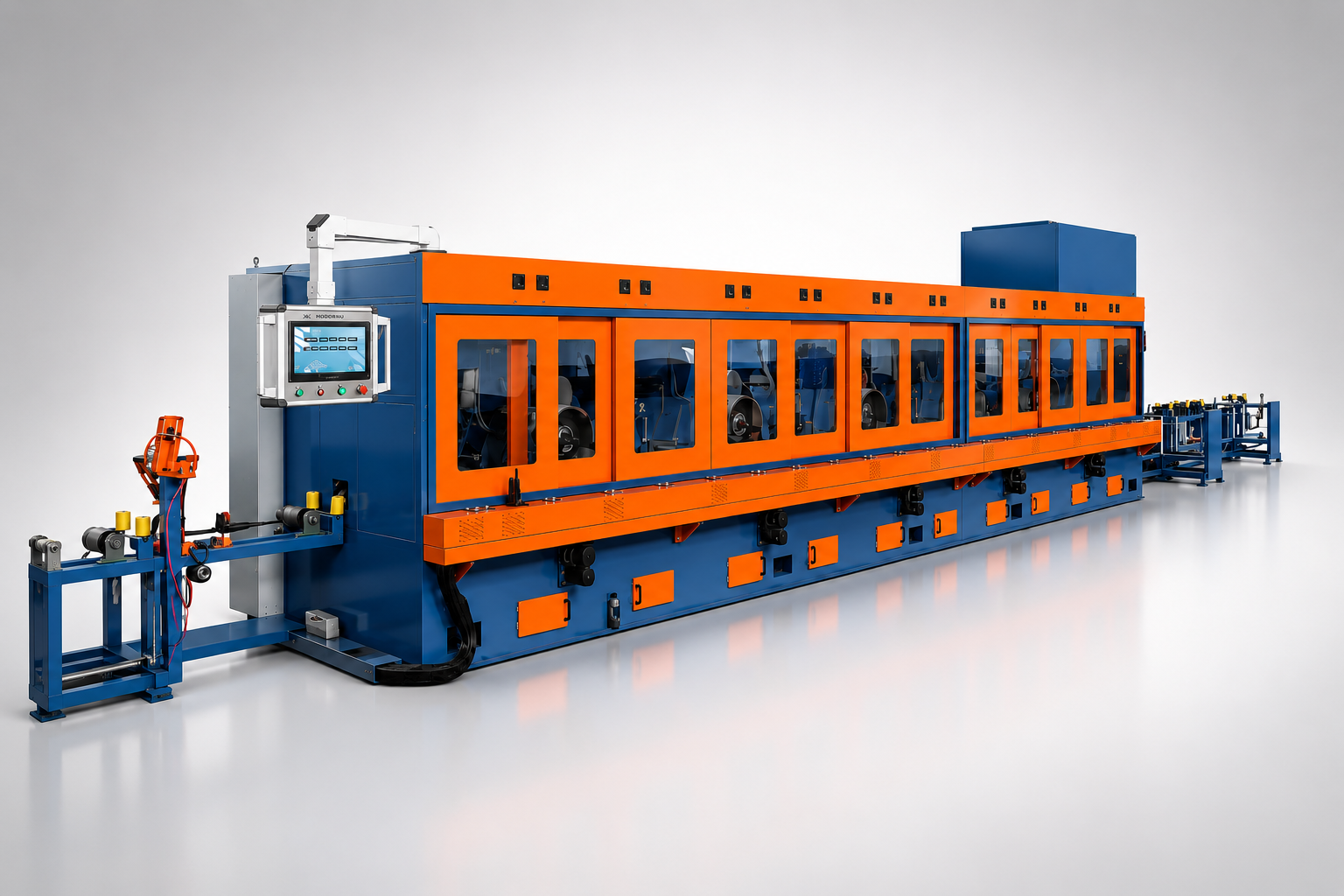
Purpose-Built for Flat Faces, Corners and Box-Section Profiles
Square and rectangular tubes require stable face-to-face abrasive contact and accurate workpiece guidance. Tailiang equipment supports controlled processing across flat surfaces while reducing pressure variation, missed edge zones and inconsistent manual results.
The machine can be configured for preliminary grinding, oxidation and scratch removal, surface refinement or decorative polishing. The appropriate layout depends on the profile width and height, material, number of faces to be processed, defect condition, desired finish and production rate.
- Square tubes, rectangular tubes and box-section profiles
- Carbon steel, stainless steel and applicable alloys
- Adjustable for a defined width and height range
- Dry or process-specific finishing setup
- Manual loading or automatic feeding options
- Standalone or integrated production-line use
How Square & Rectangular Tube Polishing Works
The system controls profile alignment, flat-face abrasive pressure and feeding speed so the required surfaces receive a repeatable finish.
Profile Loading & Alignment
The tube enters the guide and feed system, which maintains face orientation and stable linear travel.
Flat-Face Abrasive Contact
The selected polishing unit applies controlled pressure across the target face according to the required stock removal.
Multi-Surface Processing
Additional heads or planned workpiece orientation process the required faces while controlling visible finish variation.
Finished Profile Discharge
The processed profile exits for inspection, packaging or transfer to the next manufacturing operation.
Designed for Stable Quality and Efficient Production
The machine architecture addresses the practical problems of hand polishing: variable pressure, inconsistent coverage, high labor input and limited batch repeatability.
Consistent Flat-Face Finish
Controlled abrasive contact helps maintain an even appearance across broad flat surfaces.
Continuous Feeding
Stable material transport improves throughput and reduces repeated manual repositioning.
Repeatable Process Settings
Defined pressure, abrasive and feed settings make batch results easier to reproduce.
Flexible Profile Range
The machine can be engineered around the minimum and maximum widths and heights used in production.
Industrial Construction
A production-oriented structure supports stable operation under repeated tube-processing cycles.
Line Integration Options
Feeding, conveying, dust handling and adjacent operations can be evaluated as one workflow.
One Machine Family, Multiple Finishing Objectives
Machine configuration should follow the actual profile, number of surfaces to process, material and target finish. Share sample images or workpieces so the abrasive sequence and station layout can be evaluated accurately.
Send Application DetailsStainless Steel Box Sections
Refining and decorative finishing for furniture, architectural frames, railings and visible metal components.
Carbon Steel Profiles
Removal of oxidation, scale and surface defects before coating, assembly or further processing.
Architectural Frames & Profiles
Consistent finishes for facade components, frames, supports and exterior or interior metalwork.
Furniture & Fixture Tubing
Repeatable surface preparation for tables, shelving, display fixtures and commercial furniture components.
Scratch & Oxidation Removal
Controlled stock removal helps prepare profiles with handling marks, surface defects or oxidized layers.
Multi-Face Decorative Finishing
Multi-stage processing can refine selected faces toward an agreed brushed, satin or polished appearance.
Build the Machine Around Your Production Requirement
There is no single ideal configuration for every square or rectangular profile. These factors determine the appropriate polishing architecture and quotation.
| Selection Item | Information to Provide | Configuration Impact |
|---|---|---|
| Profile Dimensions | Minimum and maximum outside width and height, wall thickness and workpiece length | Determines guide structure, adjustment range, face contact and material support. |
| Material | Stainless steel, carbon steel, aluminum or other alloy | Influences abrasive selection, contact pressure, heat control and expected surface response. |
| Incoming Surface | Oxidation, mill scale, scratches, weld marks or general roughness | Defines required stock removal and whether coarse-to-fine multiple stages are needed. |
| Target Finish | Cleaning, preparation, brushed, satin, refined or application-specific finish | Guides abrasive sequence, polishing media and number of processing stations. |
| Required Output | Pieces per hour, meters per minute, shift pattern and batch size | Determines feed system, motor and station layout, automation level and line integration. |
| Factory Conditions | Available footprint, power supply, dust collection and upstream/downstream equipment | Influences machine arrangement, enclosure, utility interface and installation planning. |
Application-Focused Equipment Support
The result depends on more than the machine body. Workpiece support, abrasive selection, station sequence and feed control must work together as one finishing process.
What to Send for a Faster Technical Recommendation
A complete inquiry helps the engineering team avoid assumptions and prepare a more useful machine proposal.
- Profile width and height range, wall thickness and length
- Material grade and current surface condition
- Required visual finish or roughness target
- Expected production capacity and working hours
- Sample photos, drawings or physical workpieces if available
- Power supply, plant layout and dust-handling requirements
Square & Rectangular Tube Polishing Machine FAQs
Practical answers to the questions buyers commonly ask before requesting a detailed configuration.
The equipment is intended for square tubes, rectangular tubes and suitable box-section profiles. The exact width, height, wall-thickness and length range must be confirmed for the selected machine configuration.
Yes. The guide, feed and polishing-contact systems can be made adjustable within a defined range. Provide your minimum and maximum widths and heights so the working range and changeover method can be evaluated.
It can be configured for defect and oxidation removal, but the required abrasive and number of stages depend on defect depth, material and target finish. Photos or samples are recommended before final selection.
A single station may suit one defined operation. Multi-station systems are more appropriate when coarse defect removal, intermediate refinement and final finishing must be completed continuously at a higher output.
Automatic feeding, conveying, multi-face station layouts, dust-extraction interfaces and connection with adjacent equipment can be evaluated according to the profile format, line speed, plant layout and automation target.
Please provide profile width and height, wall thickness, length, material, number of faces to process, incoming surface, required finish, production capacity and factory conditions. This information allows a technically relevant configuration and quotation.
Get a Square & Rectangular Tube Polishing Solution Matched to Your Profiles
Send your width and height range, profile length, material, number of faces to process, surface condition, target finish and required capacity. Tailiang will recommend a practical machine layout and prepare a detailed quotation.